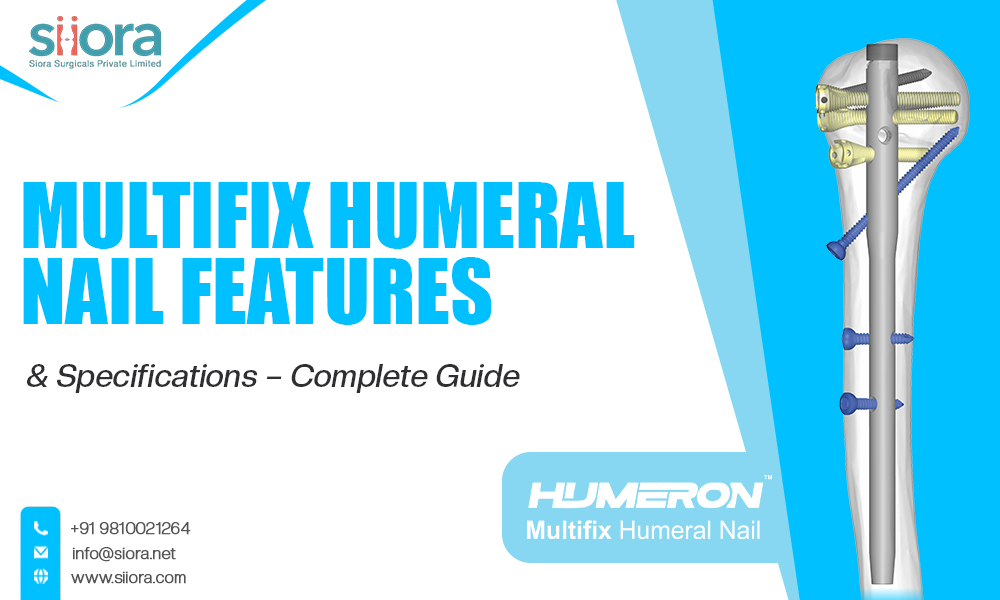
Humerus fractures can be tricky, especially when they involve both the proximal segment and the shaft or when bone quality is poor. In those situations, a humeral nail that offers strong fixation, multiple locking options, and smooth instrumentation makes a real difference in the OR and in patient recovery. The Multifix Humeral Nail is built precisely for that role, combining solid biomechanics with practical, surgeon-friendly design.
What Is the Multifix Humeral Nail?
The Multifix (in concept very similar to modern multi-locking humeral nail systems) is an intramedullary implant designed to stabilize fractures of the upper arm from within the medullary canal. It is used for:
- Proximal humerus fractures
- Shaft fractures
- Fractures extending from the head into the diaphysis
- Pathological fractures and nonunions where reliable internal support is needed
By sitting inside the bone, the nail works as a load-sharing device, which helps protect soft tissue, preserve periosteal blood supply, and allow earlier mobilization compared with bulky plates.
Core Design Features
A few key design elements define the Multifix-type humeral nail:
- Cannulated titanium body: The nail is hollow (cannulated), which allows insertion over a guidewire for accurate placement while keeping the implant lightweight and strong.
- Multiple diameter options: Common diameters in these systems are around 7.0 mm, 8.5 mm, and 10 mm, so surgeons can match the canal size without over-reaming or risking cortical damage.
- Length range: Nails are typically available from about 180 mm up to 315 mm, usually in 15 mm increments, covering isolated proximal fractures as well as long segment diaphyseal injuries.
- Straight or gently contoured profile: A largely straight design with a central entry point improves anchorage in strong subchondral bone and helps avoid insertion through the fracture line in multi-part proximal fractures.
Together, these features create a versatile system that can be adapted to simple and complex humeral patterns.
Locking Options & Screw Technology
Where Multifix-style systems really stand out is in their locking strategy:
- Multiple proximal locking holes: Several screw trajectories allow secure fixation of the humeral head and tuberosities, improving rotational stability and control of the greater tuberosity.
- Screw-in-screw or similar augmentation: Advanced designs use a “screw-in-screw” concept or secondary locking within the main screws to improve purchase in osteoporotic bone.
- Calcar or ascending screw: One of the proximal options often targets the medial calcar region, supporting the inferomedial head and reducing varus collapse.
- Compression capability: Some nails allow controlled compression across transverse or short-oblique shaft fractures using a dedicated compression screw, enhancing contact and rotational stability.
Distally, three locking screws in different planes help prevent toggling and control both length and rotation, even in distal diaphyseal fractures treated through an antegrade approach.
Indications & Clinical Use
Typical indications include:
- Two-, three-, and four-part proximal humerus fractures
- Proximal fractures with shaft extension
- Isolated humeral shaft fractures
- Impending or actual pathological fractures where spanning the whole humerus is beneficial
These nails are usually inserted antegrade via a small entry point at the humeral head, with careful handling of the rotator cuff to reduce postoperative shoulder symptoms. In complex cases (e.g., combined proximal and shaft fractures), a long nail can stabilize both regions with one construct, avoiding separate trauma implants.
Instrumentation & Surgeon Convenience
Modern humeral nail systems, similar to Multifix are built around streamlined instruments:
- Color-coded components to simplify assembly and reduce confusion in theatre
- Self-holding sleeves and screwdrivers that make it easier to work through small incisions
- Reversible aiming arms that work for both left and right sides, cutting inventory and setup time
These details may sound minor, but they translate into shorter operative times and fewer intraoperative errors—especially in high-volume trauma settings.
Why Multifix-Type Nails Stand Out?
In practice, a well-designed humeral nail system offers:
- Stable fixation even in osteoporotic or pathological bone
- The ability to treat proximal, shaft, and combined fractures with one platform
- Options for calcar support and compression, which improve union and alignment
- Minimally invasive insertion, preserving soft tissues and blood supply
For surgeons, that means flexibility and confidence; for patients, it often means earlier shoulder and elbow motion, reliable union, and a faster return to daily activities.
 siiora surgicals pvt. ltd